
- 7.1 The Courtroom
-
The courtroom and its processes can be intimidating, especially if you have never been to court before. If you can, you should spend some time watching trials or hearings to get comfortable with what you might experience. It will especially be useful to see how other people present before the judge.
Courtrooms are almost always open to the public, so (subject to usual security checks) you are free to walk in and out as you please. You will be able to find information about what hearings are happening in which courtroom in the hallway. Usually there are boards or screens with posted lists of proceedings for that day. If you need additional assistance, you may ask the court staff and they can help you.
It would also be a good idea to brush up on expectations of courtroom behaviour before your visit. The last thing you want to do is be disruptive when court is in session.
Courtroom layout
Courtrooms come in different shapes and sizes, but they have common features.
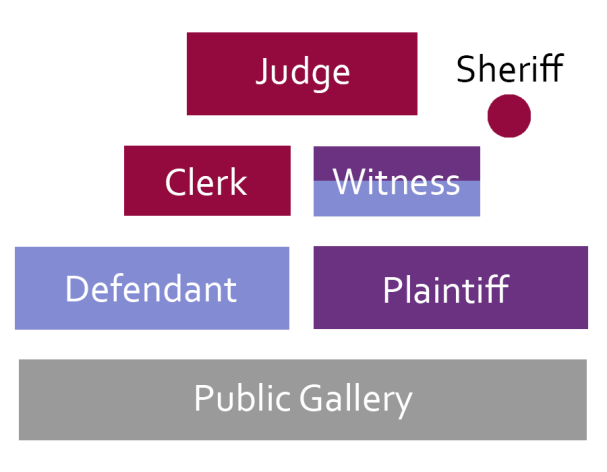
Usually there will be a raised bench opposite from the door you use to walk into the courtroom. This is where the judge or master (a judicial officer) sits when the court is in session. The judge or master is the decision maker.
Below the bench to the right or left is the court clerk. The court clerk is the person who helps the process run smoothly administratively. The clerk will be the person who accepts exhibits, administers oaths to witnesses, keeps track of proceedings, and helps the court stay organized and efficient. The clerk will command everyone to rise when the judge enters and exits the courtroom. Listen to the clerk’s instructions, like you would listen to the judge.
At certain hearings a court reporter may be sitting near the clerk. The court reporter’s job is to record everything that is said at the hearing for later use. Alternatively, there may only be an electronic recording being taken to capture everything being said. A transcript of the hearing might be useful to a party who wants to launch an appeal.
There is often a raised seat near the court clerk. This is called the witness box. If you are testifying, or having a witness coming to testify at one of your hearings, this is where they will be when they are speaking to the court and being questioned.
In most courtrooms, the parties sit across from the judge’s bench at separate tables. At your hearing / trial you will sit at one table, and the other party and their lawyer (if they are represented by one) will sit together at the other.
A sheriff may be present, if required for security purposes. A sheriff is a uniformed peace officer who maintains order and security in the courtroom. The sheriff might stand or sit somewhere in the courtroom. They will keep track of who is entering and exiting the courtroom. Listen to the sheriff’s instructions, like you would listen to the judge.
Some courtrooms may have another section of seating to the side of the room. This is called the jury box. This is where jurors sit as they listen to proceedings.
Finally, the general public and people interested in your case, such as friends or family, are welcome to sit in the public seating at the back of the courtroom. This section is called the gallery. The gallery is separated from the rest of the courtroom by a railing called the “bar”. The only people that can pass through the bar into the inner part of the courtroom are lawyers and people who are directly involved in the case. If you are not involved in the case, you may not cross the bar.
- 7.2 Behaviour in Court
-
Court can be a stressful experience. It is a formal place that puts a strong emphasis on process. If you are going to court, there are some things you need to keep in mind.
- Be courteous and respectful at all times
It is your responsibility to be respectful and courteous to everyone in court at all times, no matter what happens. You can expect to be treated with the same respect and courtesy by the judge and the court staff during the process.
Everyone will have a chance to speak in court. Be patient and attentive. Never interrupt anyone when they are speaking, unless you have an objection to what is being stated (in which case you can/stand and make your objection, and the judge will rule on it – See Section 9.9 for more detail).
Do not make a scene if the judge or the other party says something with which you disagree. You will get an opportunity to respond. Rolling your eyes or being sarcastic or offensive will not help you. Be respectful at all times, no matter how you are feeling about what is being said.
- Keep your emotions in check
Whatever happens at your hearing, you are going to be better off if you remain calm at all times. Court can be highly emotional. During your trial, you might hear evidence or arguments, or be asked questions that make you feel uncomfortable. If you are asked an uncomfortable question, try your best to give the most truthful, professional reply you can give.
- Arrive early
You should arrive at court at least fifteen minutes before your hearing / trial so that you have enough time to get to the right courtroom. Many courthouses have security checks that take time to get through-similar to going through security at an airport. Make sure you are not late for court.
- Dress appropriately
You should dress as professionally as possible. Jeans, hats, shorts, low cut tops, or short skirts are not appropriate. You should be neat, modest, and well-groomed for your court appearance. Dressing in a neat and professional way will help show the judge that you are serious about your case and respectful of the court process. You want to make a good impression.
- Speaking in court
When you are in Provincial Court, generally the proper way to address the judge is “Your Honour”. When you are in a superior trial court, the proper way to address the judge is usually “My Lord” or “My Lady”. If in doubt you can use “Judge” in provincial court and “Justice” in a superior trial court. Refer to the jury as “the jury” or “members of the jury”. You should call everyone else by their title and last name (Mr. _____________ or Ms. ______________).
Do your best to speak clearly and calmly when it is your turn to speak. Take your time. Do not use slang words and be mature about the way you address the court. You always want to make a good impression.
- Court Protocols
There are expectations for how people act in court. You should stand whenever the judge enters or leaves the courtroom (to show respect). If there is a jury, stand when the jury enters or leaves the courtroom (to show respect). Stand when you wish to say something. You should address all of your comments to the judge.
- 7.3 Presentation Skills
-
Speaking in a courtroom can be especially nerve-wracking. But do not worry. There are strategies and tools that can help. Learning how to be an effective presenter will help you be effective in presenting your case and give you more confidence in front of a judge.
- Preparation
You usually only have one opportunity to present your case. To make good use of your opportunity, think about what you want to say beforehand.
You should be prepared to inform the judge about relevant facts and issues, and to make convincing legal arguments. You will also want to be flexible enough to answer any questions the judge has and to address any unexpected issues that arise. Be prepared to modify your approach to the situation presented to you. The best strategy is somewhere in between improvising and reading a script. Ideally, you should have a list of points that you need to cover. These points can be keywords or short phrases. You should refer to this list while you are speaking. But you should have practiced enough to not stare at the list all the time.
- Be Organized
Make sure that you are organized and ready for your chance to tell your side of the story. You should know where all of your paperwork is, and you should not waste time fumbling around in a folder. It is a good practice to organize all of your paperwork with tabs that can be easily referenced by you and the judge.
- Practice
Practice really does make perfect. Try to get your practice to imitate what it is going to be like in court; speak standing in a clear voice.
Practice in front of a friend or family member. You can also videotape yourself or practice in front of a mirror. Seeing how you present may reveal some of your habits, such as distracting hand gestures. The more you practice, the less nervous you will get.
- Be Clear
Speak slowly and audibly. You want the judge to understand what you are saying. Do not be afraid to pause a few seconds between ideas instead of barreling through your presentation. Do not yell, but make sure that the judge and the other party can hear every word you are saying. In court, it is important to make eye contact with the judge when you can. If the judge is looking through paperwork to get to evidence you are talking about, you should pause your speaking until the judge has found the right place and is able to pay attention to what you are saying.
- Be Truthful and Professional
When you are giving evidence under oath, tell the judge the whole truth. Do not be misleading by telling half-truths or exaggerations. The danger with half-truths and exaggerations is that the judge might not find them credible and you might contradict yourself. If this happens, your credibility will suffer. The judge might not trust you even when you are telling the truth, because you haven’t been completely truthful before. Be professional when you speak. Do not use sarcasm or derogatory language.
- Be Confident and Direct
Try to avoid starting every sentence with “I think” or “I believe”. These words make you sound uncertain. Also, avoid verbal fillers. These are the “um” and “ah” that you tend to say during a casual conversation. But in court, these fillers are distracting.
Overall, when you sound confident, you are more credible. Having good posture makes you look confident and more credible. Try not to slouch, fidget, or lean against the table. When you are speaking, keep eye contact with the judge. This will help you engage the judge. But, it is okay to look at your notes from time to time.
- Be Respectful
Even though you are trying to put forward your side of the argument, it is important to be respectful to everyone in court including the other side. This makes you look professional.
Never make a personal attack on anyone in the courtroom.
- Answer the Judge’s Questions
If the judge asks you a question, stop speaking immediately and listen to the question. If the judge has a question, that means they need clarification. The judge needs to fully understand your story to be convinced.
Listen to the entire question before you answer. A trial is not a test to see how quickly you can answer the judge’s questions. Feel free to pause and think about the question before answering.
If you cannot hear the entire question or if you do not understand what the judge is asking, you can ask the judge to repeat or explain the question. It is critical to make sure that you are answering the right question.
Even if your answer weakens your position, give your answer anyway. If you ignore or avoid a question, the judge will not be impressed. Remember, do not argue with the judge. Always be respectful, even if the question weakens your position.
- 7.4 Managing the Stress of Trial
-
Going through a trial can be very stressful. At times it may feel frustrating and emotional. It is vital that you take care of yourself leading up to your trial date as well as during.
Here are a few tips to keep in mind:
- Stick to the plan: Remind yourself what is important to you. Revisit your goals. Try not to get caught up in a battle mentality. It is not about revenge.
- Stay calm: Take deep breaths or write notes on your page to remind yourself to relax. Do not let your emotions control you.
- Have support: Bring someone you trust to court with you. They cannot talk to you while court is in session, unless allowed by the court, but during breaks and lunch they can give you support and encouragement. In most jurisdictions, if you want to have the person sit with you in court, you can ask the judge permission to have a “McKenzie Friend”.
A McKenzie Friend is allowed to sit with you during the trial, and may provide moral, emotional and practical support like organizing documents and taking notes. They can make quiet suggestions to you, but they cannot address the court or give you legal advice.
- Believe in yourself: Tell yourself you can do it. You have worked hard to get here, so be confident.
- Fuel your body: Make sure to eat something nutritious before court. When in the courtroom, you cannot eat or drink anything except water.
- Rest: Get a good night’s sleep before trial. It will benefit you more to be well rested then to stay up preparing all night the night before.
- Stretch: There will be an opportunity to walk around during the court’s breaks. Make sure you stretch out your legs at this time.
- Breathe: Take deep quiet breaths to help you stay calm and focused.
- Be Professional: Stay collected, objective and courteous. Keep calm.
To help you prepare fill out the Before Court Checklist.
- 7.5 Before Court Checklist
-
To be sure you are ready for court, consider the following checklist:
- Reviewed and disclosed all the court documents, including the initial documents that started the claim, and the responses.
- Clearly understand the timeline of the case. Able to tell the judge, in chronological order, the relevant history of the court proceedings if the judge is not aware of them.
- Prepared all witnesses. They have been served with a subpoena / summons which lets them know where and when to come.
- Organized all documents and case law.
- Have the original document evidence (to be handed to the clerk) and 3 copies (for the other party, judge and yourself) of all document evidence.
- Prepared strategy for trial, opening statement, and questions for the witnesses.
- Wear appropriate clothing in court.
- Eat a healthy meal before court.
- Had a good night sleep before going to court.
- Know the time and place of your court appearance and plan to arrive early.